By: Andrew Warren
Contributing Writer
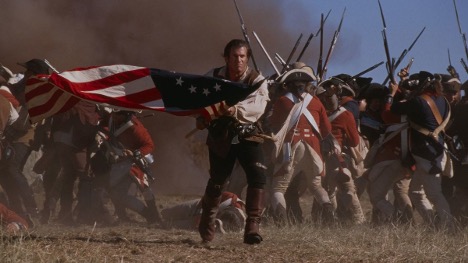
On November 14, Vol State and The Palace Theater came together for their fourth installment of their ‘History at the Movies’ series, with a screening of Roland Emmerich’s 2000 action-war film, The Patriot.
The Patriot, set in 1776 South Carolina, stars Mel Gibson as Benjamin Martin, a former soldier who battled in the French and Indian wars. When he decides to put his past behind him, his son Gabriel (Heath Ledger) enlists to defend his land against the British in the Revolutionary War. Benjamin begrudgingly decides to fight beside his son to retaliate against the British Colonel, William Tavington (Jason Isaacs).
Following the screening, Professor Scott McMillan provided a brief history lesson on the historical figures and locations that helped inspire the film, along with the accuracy and inaccuracies of the dramatized war film.
Professor McMillian noted that Mel Gibson’s character, Benjamin Martin, was based on four historical figures: Francis Marion, Andrew Pickens, Daniel Morgan, and Thomas Sumter. Sumter was South Carolina’s Senator from 1801-1810, and is after whom the historical Fort Sumter in Charleston Harbor, SC, is named. Main antagonist Colonel William Tavington, played by Jason Isaacs, is based on General Sir Banastre Tarleton, who led the British army near the end of the Revolutionary War.
The final battle is based on a real-life battle in South Carolina known as the Battle of Cowpens, which occurred on January 17, 1781. The battle was fittingly led by Daniel Morgan and his American army to defeat a British army led by General Sir Banastre Tarleton. Morgan led around 1,100 men compared to Tarleton’s 1,150, which brings up one of the first historical inaccuracies of the film. The final battle was played out to be a sea of red coats outnumbering the Continental Army, leading to an epic comeback by the Americans. While the defeat was an embarrassing loss for the military powerhouse that was the British Army, the number of soldiers shown is historically inaccurate.
Professor McMillian spoke out about many criticisms this film faces because of its historical inaccuracies. For example, to make our main protagonist, Benjamin Martin, more heroic, producers decided Martin would be written as a plantation owner who hires free African American workers instead of slaves to work on his plantation. The decision drew a lot of controversy, as it was highly criticized for showcasing a prominent plantation owner as someone who didn’t own slaves, which wouldn’t have been the case at the time. But it isn’t the only controversial decision the film made when it came to the portrayal of slaves in the film.
A prominent side character, Occam, played by Jay Arlen Jones, was a slave who volunteered to sign up for the army. Throughout the film, it is mentioned that he only needs to serve 12 months to be granted freedom. While there were laws where slaves could be awarded freedom, South Carolina was not a state that allowed such laws, meaning that if the film were historically accurate, Occam would never have been free. It leads to a big question for people who start to understand the real history of the Revolutionary War: Why should we be so patriotic?
The film is clearly anti-British, which makes sense due to the film being a patriotic propagandistic film. And Professor McMillian pointed out a few facts that were not mentioned in the film. First and foremost, the British had taken and offered freedom to more slaves than the Continental Army. And possibly the most emotional scene in the film, when the British burn down a church full of townsfolk, there is no proof of such an action, being completely fictionalized for the film’s emotional sake.
While Roland Emmerich’s The Patriot is concerningly historically inaccurate by taking a more propagandic approach, the film still does a great job at showcasing the heroism of many soldiers who risked and sacrificed their lives for our freedom. Professor McMillian’s insight into the real history of the Revolutionary War gives us a good representation of what healthy patriotism should be, and that is understanding the ups and downs of our history, but still being proud of what we’ve accomplished and what will be accomplished in the near future as Americans.
Vol State and The Palace Theater will continue their ‘History at the Movies’ series on Thursday, February 12, 2026, screening the Oscar-nominated Spike Lee biopic, Malcolm X (1992) to celebrate Black History Month. Future screenings include Penny Marshall’s A League of their Own (1992) on March 12, and John McTiernan’s (Die Hard) 1990 film The Hunt for Red October. If you love movies and history, come down to The Palace Theater, located on the Gallatin Square, to catch these upcoming screenings followed by an engaging 15-to-20 minute lesson on the real history of these films.











Be First to Comment