By Andrew Warren
Contributing Writer
Sinners is Ryan Coogler’s fifth feature film, but it’s finally his first time cashing in his blank check. He signed a historical contract with Warner Bros., only given to a handful of filmmakers, granting him full ownership of the film after 25 years. After releasing his directorial debut, the true story drama Fruitvale Station, along with three franchise blockbusters in Creed and the two Black Panther films, Coogler finally gets to truly express himself with a completely original film in Sinners.
Coogler has already shown expression of black culture in his past films, but he takes it to another level, making it the driving force of the entire film. Sinners is a film that tackles black culturalism, cultural vampirism, the oppression of African Americans in the 1930s, the power of music and art, and even some subtle hints of spirituality, specifically the different interpretations of Christianity. I believe all of these themes to be important to look at, not just for the film’s sake, but because people can relate to this film and have many different perspectives on many of the themes expressed in this monumental film.
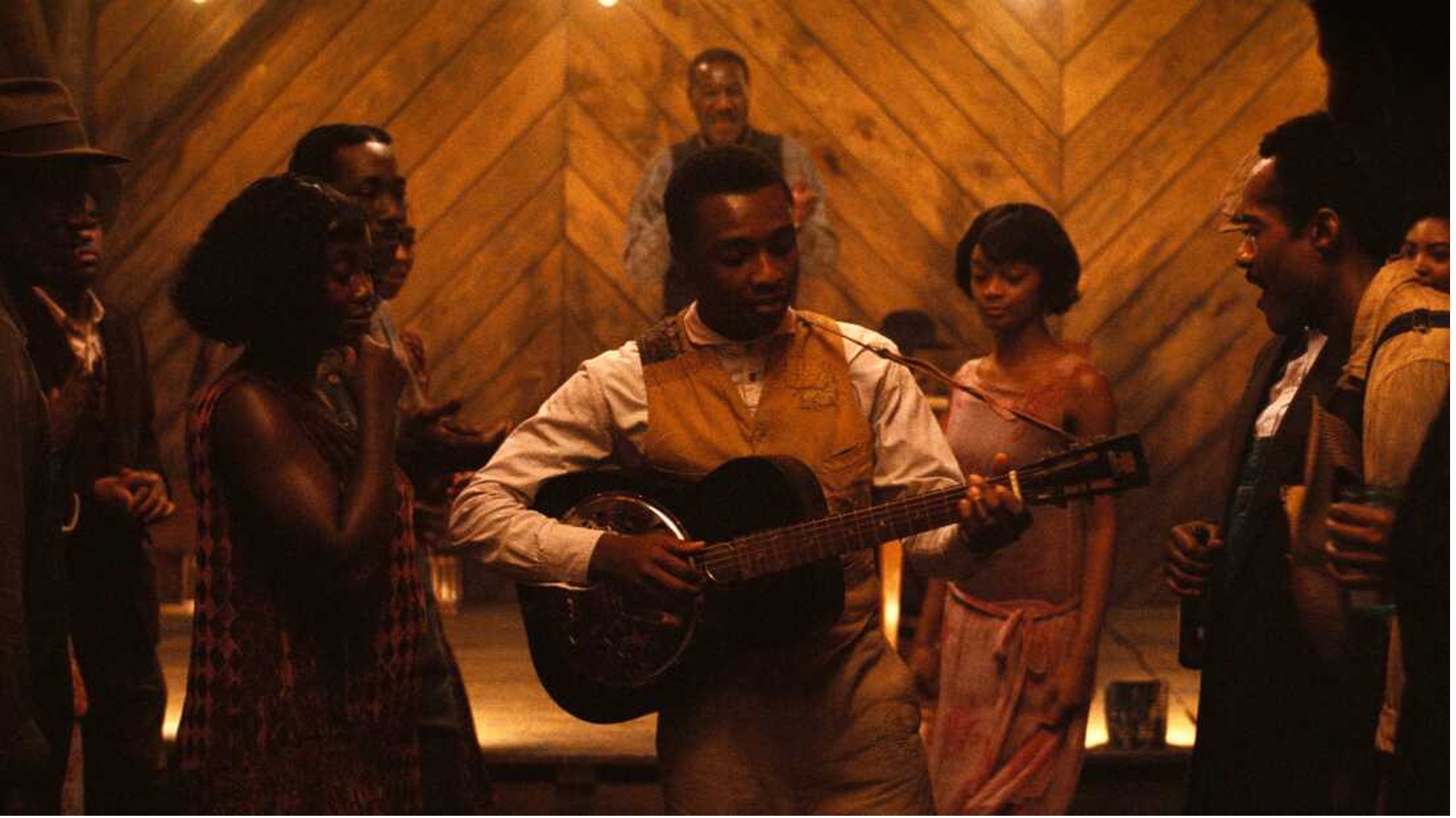
Sinners stars Michael B. Jordan, who plays two roles as twins Smoke and Stack, who return home to pay back their town and culture by opening a juke joint as a way for African Americans in the Jim Crow south to let loose and enjoy the art of dance and music amongst a nation actively oppressing them. They invite their cousin Sammie, played by first-time actor Miles Caton, to help bring this juke joint to life with his musical talents. As the night rolls along, they are faced with the main conflict of the film: vampires who seek to kill and steal the culture that has brought them together.
Ryan Coogler shot his film on 65mm film with IMAX cameras, creating a 1.43:1 aspect ratio, the largest possible resolution you can achieve. And Coogler highlights this large format with a transcendent five-minute one-take. It takes you through music and dance in black culture from the past, present, and future. Starting with Sammie singing the blues, to the electric guitar (a nod to Jimi Hendrix and others), to record scratching hip-hop, to modern-day rap, while all being surrounded by dances that range from the ‘30s to today. Coogler’s faithful composer, Ludwig Göransson, showcases yet another piece of history in his score for Sinners. He mixes a multitude of musical genres, ranging from the blues, to bluegrass, to rock, to metal, to hip-hop; he has it all. And his score makes the scene even more emotional. There’s no doubt this score earns Göransson his fourth Oscar nomination. The scene ends in a shot of the three main antagonists looking over the barn, as they begin their hunt for Sammie’s musical talent.
Coogler tackles themes of oppression with his film being set in 1930s Mississippi. While slavery was abolished, many African Americans were all but forced to stay employed by landowners through sharecropping. An agreement where the landowner allows a split of his crops to his tenants. This is where we are introduced to our villain, Remmick, played by Jack O’Connell. He’s an Irish fallen angel in search of Sammie’s musical talents, which leads to its theme of cultural vampirism. Remmick wants to steal and exploit their cultural traditions, calling it their own, with no appreciation for the ones who founded it. And that’s the big question amongst the characters: Who is welcome and who isn’t?
The final act of this film is a powerful and violent confrontation between the vampires and those who remain. And this is where Christianity plays a role in Sammie’s beliefs. Before the night, Sammie worked as a sharecropper and lived on the plantation with his father, who was a pastor at the plantation. In Sammie’s final confrontation with Remmick, he is seen praying. Remmick and the other vampires recite his prayer in unison as Remmick tells Sammie, “Long ago, the men who stole my father’s land forced those words upon us. I hated those men, but the words still bring me comfort.” This line reveals Coogler’s intention to portray Remmick as Irish, and it makes him a rather sympathetic villain, although his intention of taking Sammie’s talents is exploitative. The Irish were enslaved by the British colonies in the late 1600s. And the evil slave owners in both Britain and the South would use Christianity for power, rather than for good. My interpretation is that Sammie’s prayer was answered, but it wasn’t by an angel swooping down to rescue him, but by leaving enough time for Smoke to finish Remmick off before it was too late. The end-credit scene shows Sammie, seemingly before the night, singing “This Little Light of Mine” inside his father’s church with the guitar his father gave him. It is a scene I interpreted as a sign of his acceptance of his Baptist upbringing, also marking a change in Christianity by expressing black culture through not only music but also faith.
Sinners is a monumental masterpiece and has a little something for everyone. I honestly have no idea where Ryan Coogler can go from here after creating a film that hits everything home and to perfection. It has been months since I’ve had the urge to leave my house and drive 30+ minutes to catch a movie when streaming services are taking over, but Ryan Coogler’s Sinners has brought me and many others in, grossing nearly $300,000,000 on a $90,000,000 budget. I hope Sinners has awoken the world to go to the movies more, as I find cinema to be an important part of our culture as human beings.






Be First to Comment